Spring Lock vs Digital Activation: How Boiling Water Tap Safety Actually Works
If you are considering a boiling water tap for the first time, safety is probably one of the first questions on your mind. It should be. These taps deliver water at up to 98 degrees Celsius, and that is not something to take lightly in a kitchen where children come and go, or where anyone might reach for the tap without thinking.
The good news is that every boiling water tap we sell at hotwatertaps.ie is built with a deliberate safety system. Accidental activation is not possible in the way it is with a kettle. You cannot brush against the handle and get boiling water. You cannot bump it or knock it. Both types of safety mechanism on our range require a conscious, coordinated action before boiling water flows.
Where things differ is in how that action works, and which one suits your household better. There are two distinct approaches: a mechanical spring lock, and a digital three-second touch activation. Both work. Both are safe. They just work differently, and understanding that difference matters when you are spending this kind of money.
The Mechanical Spring Lock: How It Works
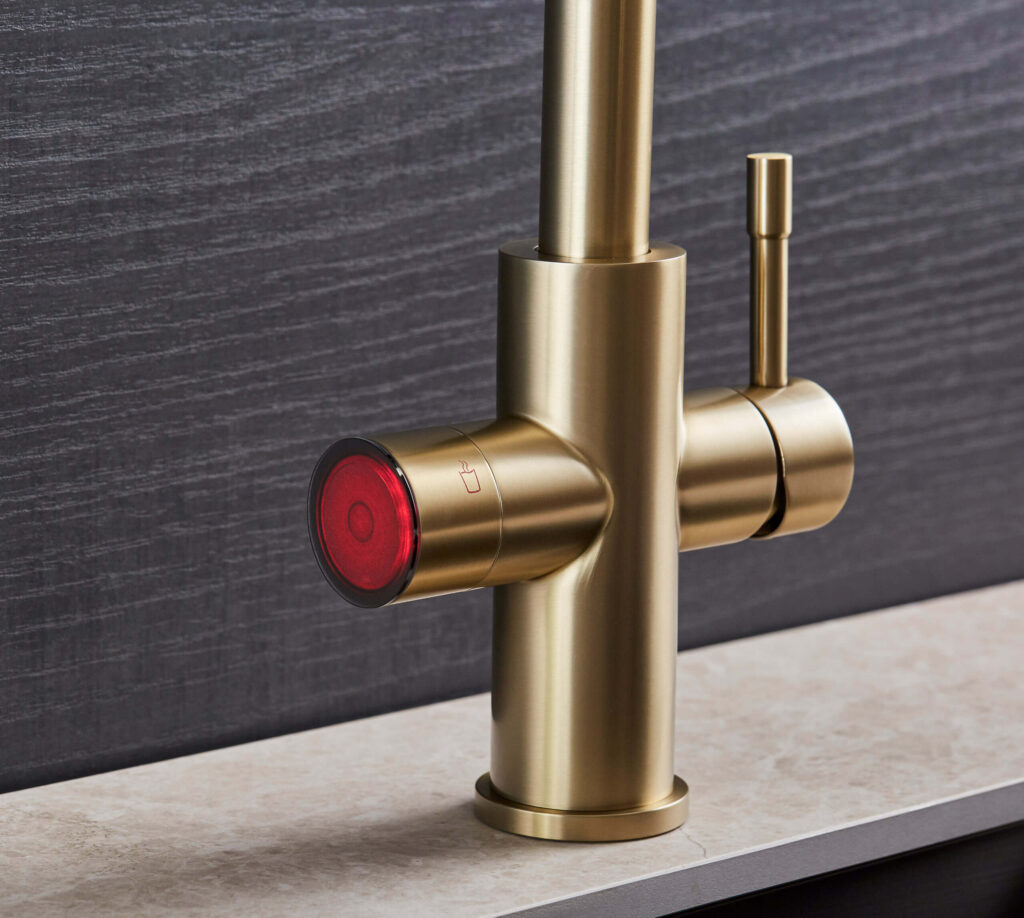
The spring lock mechanism is a physical safety system built directly into the handle or lever of the tap. It is used across a number of taps on the site, with the Platina pull-out tap being a good example of it in action.
To access boiling water, you need to press down on the spring lock and hold it while simultaneously operating the tap. The spring keeps the mechanism under tension, which means releasing it at any point cuts off the boiling water immediately. You cannot accidentally lean on it, rest your wrist against it, or have it triggered by anything other than a deliberate two-handed action.
This kind of mechanism has been used on boiling water taps for years, and for good reason. It is tactile. You can feel it working. There is a physical resistance to pushing through, which makes it immediately obvious when you are in the boiling function. Some people find that reassuring, particularly those who like a clear physical cue rather than relying on a display or indicator light.
The spring lock is also fully independent of power. It does not rely on any electronics to function. If anything interrupted the electrical side of the tap, the spring lock would still prevent accidental boiling water access. That is a minor point in practice, but worth noting for those who think in terms of fail-safe design.
The Platina pull-out tap is a good example of the spring lock in practice. It uses the mechanism alongside a forward-only handle specifically designed for tight installations close to splashbacks, with the spring lock governing access to the boiling function throughout.
The Digital Touch Activation: How It Works
The digital safety system works differently. It is the approach used on the Crystalis sparkling tap, and it reflects a more recent direction in tap design.
Rather than a physical lock you hold down, the digital system uses an illuminated touch panel on the tap. Each function has its own indicator. Chilled and sparkling water activate with a single touch. Boiling water requires a deliberate three-second press and hold before it flows.
That three-second window is not a gimmick. It is long enough to make accidental activation essentially impossible in normal use, while being short enough that it does not become irritating during the day. A quick brush against the panel will not trigger anything. A child pressing curiously at the light will not get boiling water. The action has to be sustained and intentional.
The illuminated indicators also mean you always know exactly which function is active. There is no ambiguity about what the tap is about to do. The panel shows you.
For those who prefer minimal moving parts, the digital system has obvious appeal. There is nothing to press, hold, or push against mechanically. The operation is clean, and the touch panel sits flush with the tap body so it does not add bulk or complexity to the visual.
The Crystalis comes in five finishes, chrome, brushed nickel, brushed gold, matt black, and gun metal, and combines the digital safety system with a pull-out spray spout, solid brass construction, and a 4-litre under-sink tank.
Which One Should You Choose?
There is no objectively superior system here. Both mechanisms are designed to the same standard: boiling water will not flow without a deliberate, sustained action that a child or an inattentive adult would not perform accidentally.
What differs is the interaction.
If you want something tangible and physical, something that requires you to feel the action you are taking before water flows, the mechanical spring lock is a natural choice. It is direct, independent of electronics, and familiar to anyone who has used a boiling water tap before.
If you want something cleaner in terms of operation, with visual confirmation of what the tap is doing and no moving parts to engage, the digital touch system suits that preference. It is more intuitive for households that lean toward modern appliances, and the illuminated panel makes the functions easier to distinguish at a glance.
For households with young children, both systems hold up well. The spring lock requires the kind of coordinated two-handed action that small children genuinely struggle with. The digital system requires a sustained hold that a child pressing curiously at a button is very unlikely to replicate.
The practical question worth asking yourself is this: when you reach for the tap on an ordinary Tuesday morning before you have had your first cup of tea, which kind of action would you rather take?
A Note on the Taps Themselves
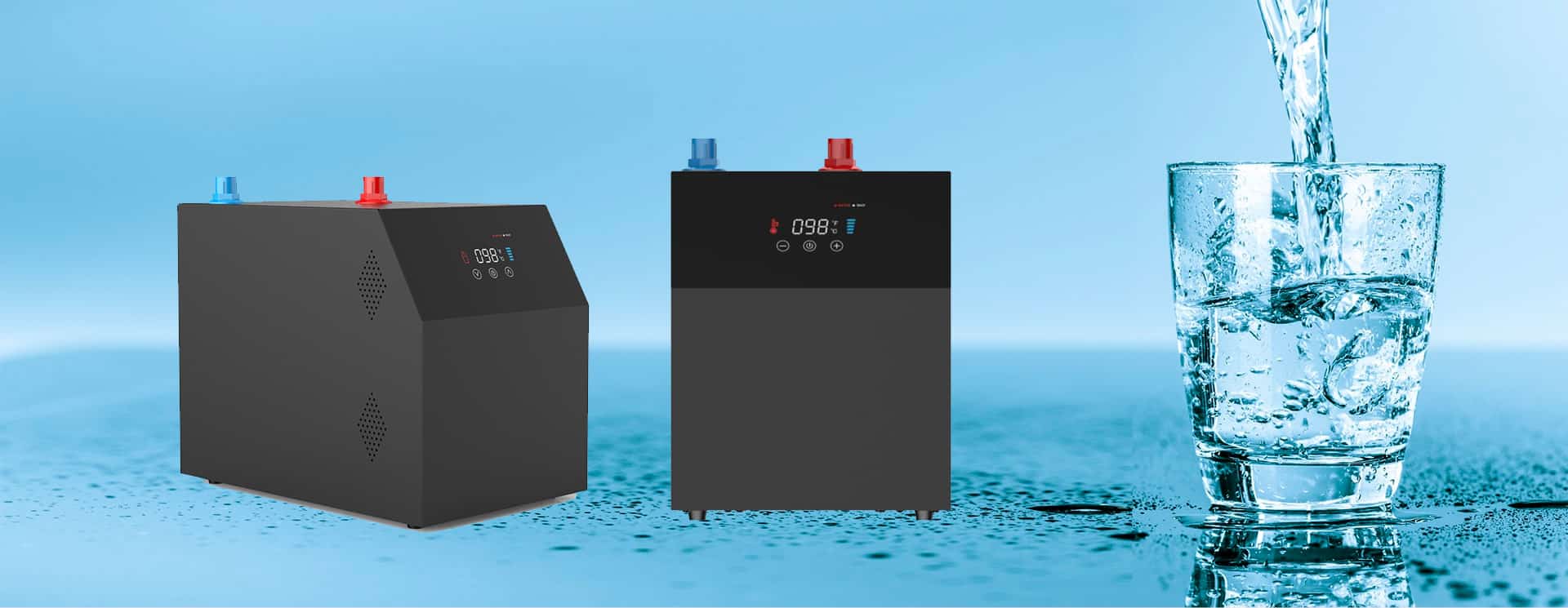
The safety mechanism is part of a broader picture. Both our spring-lock and digital tap ranges are built in solid brass, use active under-sink filtration, and deliver boiling water at up to 98 degrees Celsius from a compact tank that fits neatly in the cupboard below. The spouts are insulated so the exterior stays safe to touch even during use.
Safety with a boiling water tap is not just about the activation mechanism. It is also about not having a full kettle of boiling water that needs carrying, pouring, and not tipping over. The water stays at the sink. That single fact removes one of the most common sources of scalding accidents in the home.