Hard Water vs Soft Water in Ireland: What It Means for Your Boiling Water Tap
If you have ever noticed a chalky white crust on your kettle element, a filmy ring around your kitchen tap, or tea that looks cloudier than it should, your water is doing something your pipes were never designed to announce. Ireland has some of the hardest tap water in Europe in certain areas, and some of the softest in others. Where you live determines how quickly limescale builds up, how hard your boiling water tap has to work, and how often you will need to replace its filter.
This guide explains what water hardness actually means, how to find out what is coming out of your own tap, and what it means in practice for anyone who owns or is considering a boiling water tap.
What Is Water Hardness, and Why Does Ireland Have So Much of It?
Water hardness is a measure of dissolved minerals in your water supply, primarily calcium and magnesium. Both are entirely harmless to drink. In fact, Uisce Eireann notes that hard water’s mineral content may offer modest health benefits. The problem is not what hard water does to you. It is what it does to your appliances.
Ireland's geology explains a lot. Roughly two thirds of the country sits on limestone bedrock. As rainwater percolates down through this limestone, it picks up calcium carbonate. By the time it reaches your tap, particularly in Leinster, the Midlands, and parts of Munster, it can carry a significant mineral load. The west of the country, built on older granite and quartzite, tends to produce much softer water, as these rock types release fewer dissolved minerals.
Water hardness is measured in milligrams of calcium carbonate per litre (mg/L CaCO3). The standard classification used in Ireland runs as follows:
- Soft: 0 to 50 mg/L
- Moderately Soft: 51 to 100 mg/L
- Slightly Hard: 101 to 150 mg/L
- Moderately Hard: 151 to 250 mg/L
- Hard: 251 to 350 mg/L
- Excessively Hard: Over 351 mg/L
How Hard Is the Water Where You Live?
Water hardness varies significantly not just county to county, but supply zone to supply zone within the same county. Rather than offering a simplified county map that could mislead, the most reliable approach is to look up your own address directly. Uisce Eireann provides a free tool at water.ie where you can enter your Eircode and see the recorded calcium carbonate level for your specific supply zone.
That said, some verified figures illustrate just how wide the variation can be across Ireland. In County Meath, the Trim public water supply has been recorded at 380.55 mg/L CaCO3, which falls into the Excessively Hard category, while the Slane supply sits at 311.75 mg/L, classified as Hard. In County Sligo, the Lough Gill supply records 110 mg/L (Slightly Hard), while Riverstown reaches 320 mg/L (Hard), demonstrating that hardness can vary dramatically even within a single county. This data is drawn from Sligo County Council’s Hard Water Information Sheet. In South Dublin, the range runs from around 50 mg/L in the Ballymore-Eustace supply to up to 300 mg/L in parts of the Leixlip supply, as published in South Dublin County Council’s water quality reports.
Broadly speaking, the Midlands and central counties tend to have the hardest water due to their limestone geology. The west and northwest, particularly counties like Galway, Mayo, and Donegal, generally have softer supplies. But given the variation that exists even within individual counties, checking your own Eircode at water.ie is always the most reliable approach.
How to Check Your Water Hardness
There are three straightforward ways to find out your hardness level.
1. Use the Uisce Eireann Eircode Tool
Go to water.ie, navigate to the water quality section, and enter your Eircode. The result will show the recorded calcium carbonate level for your supply zone, based on recent lab analysis. This is the quickest and most authoritative method for households on the public water supply.
2. Use a Home Test Kit
Liquid reagent drop kits and paper test strips are available from most hardware stores and online. You fill a small vial with tap water, add drops or dip a strip, and read the result against a colour chart. Accuracy is typically plus or minus around 10 mg/L, which is more than sufficient for making decisions about filtration or maintenance. These are particularly useful if you are on a private well supply, which would not appear in the Uisce Eireann database.
3. Look for the Signs in Your Kitchen
Sometimes the most immediate evidence is already in front of you. White chalky deposits around your tap base or sink drain, a filmy residue on glassware after washing, a crusty build-up on your kettle element, or that distinctive oily-looking film on the surface of a freshly brewed cup of tea are all reliable indicators of moderately hard to very hard water. If you are seeing these regularly, your supply is likely above 150 mg/L.
What Does This Mean for Your Boiling Water Tap?
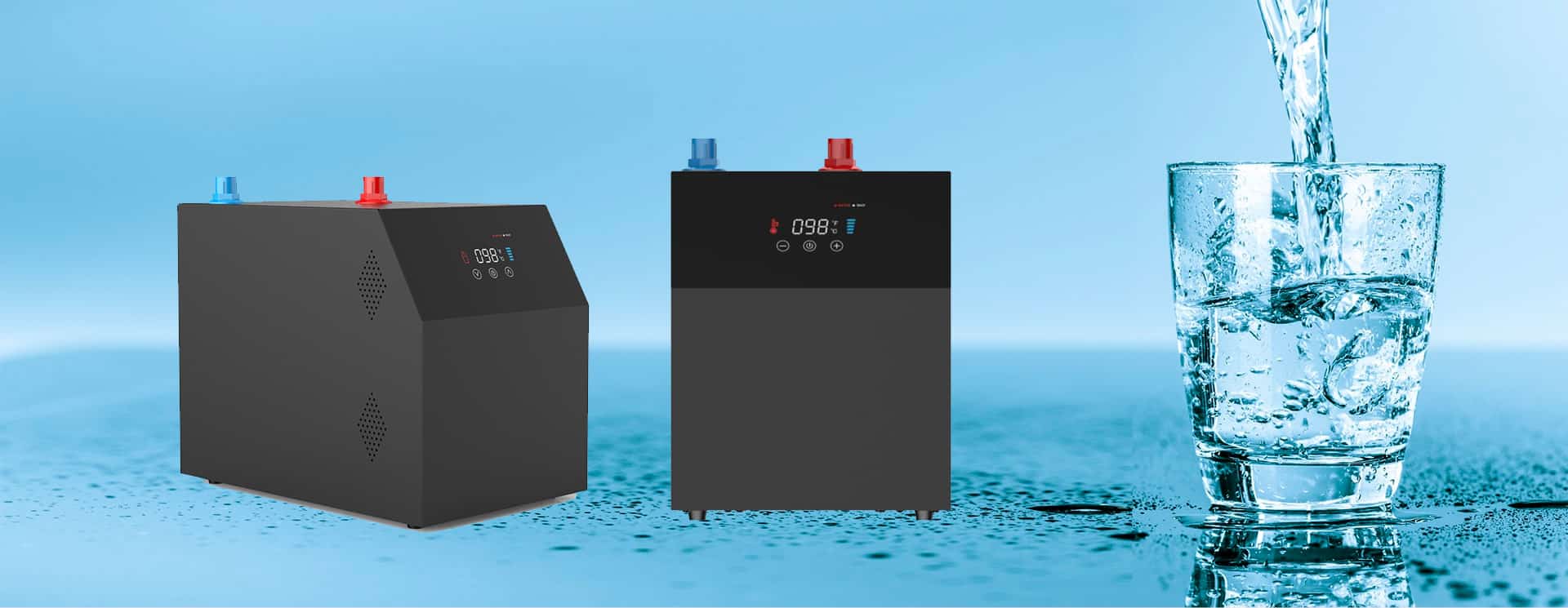
A boiling water tap heats water to around 98 degrees Celsius and holds it at that temperature inside an insulated under-sink tank. This is exactly the kind of environment where dissolved calcium carbonate becomes a problem, because heat is what causes calcium to precipitate out of solution and deposit as limescale on heating elements and internal surfaces.
The harder your water, the more calcium carbonate is available to deposit, and the faster this happens. In soft water areas, a filter may last considerably longer and the heating element may require very little maintenance. In hard water areas, the filter will work harder, potentially need replacing more frequently, and the tank and element will accumulate limescale faster if the filter is not kept on top of.
This is not a reason to avoid a boiling water tap in a hard water area. It is simply a reason to understand the maintenance your specific supply requires. Most boiling water taps include a filter system precisely because the manufacturers know that Irish and UK water supplies carry significant mineral loads. The filter does not just improve the taste of your water, it protects the tap itself.
Limescale: What Actually Happens Inside Your Tap
When hard water is heated repeatedly, calcium carbonate crystallises and adheres to the surfaces it comes into contact with. Inside a boiling water tap's tank, this means the heating element and the tank walls gradually accumulate a layer of scale. This layer acts as an insulator, meaning the element has to work harder to maintain temperature, drawing more energy and reducing efficiency over time.
Left unaddressed for long enough, limescale can affect the temperature accuracy of the tap, cause the heating element to overheat and eventually fail, and partially block the filter or internal components. None of this is dramatic or fast-moving. It is a gradual process, and one that is entirely manageable with routine maintenance.
The practical implication is straightforward: in hard water areas, filter replacement and periodic descaling matter more than in soft water areas, and letting either slip will shorten the useful life of the tap.
Filter Lifespan and Hard Water: What to Expect
Most boiling water tap manufacturers recommend replacing the filter every six to twelve months. That is a sensible guideline for average usage and average water hardness. In practice, the right interval for your household will depend heavily on how hard your water is and how much water you use through the tap each day.
In areas with water above 250 mg/L, such as parts of Meath, Kildare, or the Midlands, leaning towards the six-month end of that range is sensible. In softer water areas, a twelve-month replacement cycle may be perfectly adequate. The filter's job is to reduce the mineral load before the water enters the tank, so keeping it fresh is the single most effective thing you can do to protect the tap in a hard water area.
Some signs that your filter may need replacing sooner than scheduled include a noticeable change in the taste of the water, a reduction in flow rate from the tap, or visible limescale beginning to form around the spout or base of the tap.
Does Water Hardness Affect Which Tap You Should Choose?
For most households, water hardness should not dictate which tap you buy. All of our boiling water taps include filtration, and the filter does the heavy lifting regardless of your supply. What hardness does affect is how committed you need to be to the maintenance routine.
If you are in a hard water area and you know you are the sort of household that tends to forget about maintenance until something goes wrong, it is worth factoring the filter replacement cost and interval into your purchase decision. A tap with a more accessible or more affordable filter system may suit you better than a premium model if cost of ownership over several years is a primary concern.
If you are in a soft water area, the ongoing maintenance burden is lower, and the choice between models can focus more on design, features, and budget without hardness being a significant variable.
A Note for Soft Water Households
Soft water, while kinder to appliances, comes with its own minor quirk: it can taste slightly flat compared to hard water, because the minerals that cause hardness are the same ones that give water its familiar flavour. If you are in a soft water area and find your hot drinks tasting a little thin, this is likely the reason. It is a minor consideration, and one that most households adapt to quickly or do not notice at all.
The practical upside is that in genuinely soft water areas, limescale is rarely a meaningful problem, filter lifespan tends to be longer, and the maintenance requirements for a boiling water tap are quite modest.
Summary: Hard Water, Soft Water, and Your Tap
Hard water area (above 200 mg/L): Expect faster limescale accumulation. Replace your filter every six months. Descale the tank periodically as per the manufacturer's guidance. Check your Eircode at water.ie to confirm your level.
Moderate water area (100 to 200 mg/L): A nine to twelve month filter cycle is likely appropriate. Keep an eye on the tap's performance and adjust if you notice any of the warning signs mentioned above.
Soft water area (below 100 mg/L): Limescale is unlikely to be a significant concern. Annual filter replacement is a reasonable default. Enjoy the lower maintenance burden.
Keep Your Tap Performing at Its Best
Regardless of whether you are in a hard or soft water area, staying on top of filter replacement is the most important thing you can do to protect your boiling water tap. A fresh filter means cleaner-tasting water, a healthier heating element, and a tap that performs consistently for years.
For a step-by-step guide to replacing your filter and keeping your tap in top condition, read our full filter replacement guide on the blog.